Caribbean Capital for Real Estate Markets 2026

Caribbean Capital for Real Estate Markets 2026

gazine

Access to capital has always been one of the defining challenges—and greatest opportunities—for real estate development in the Caribbean. As global financial markets evolve, developers and investors must navigate a rapidly changing capital environment shaped by higher interest rates, tighter lending standards, climate risk, and the emergence of alternative financing sources.

This article was originally published in Uncorrelated Magazine as part of AG&T’s ongoing collaboration with Uncorrelated and EN Capital to explore innovative approaches to financing Caribbean real estate. It reflects AG&T’s commitment to connecting developers, investors, family offices, private credit providers, and institutional capital with opportunities throughout Puerto Rico and the broader Caribbean.

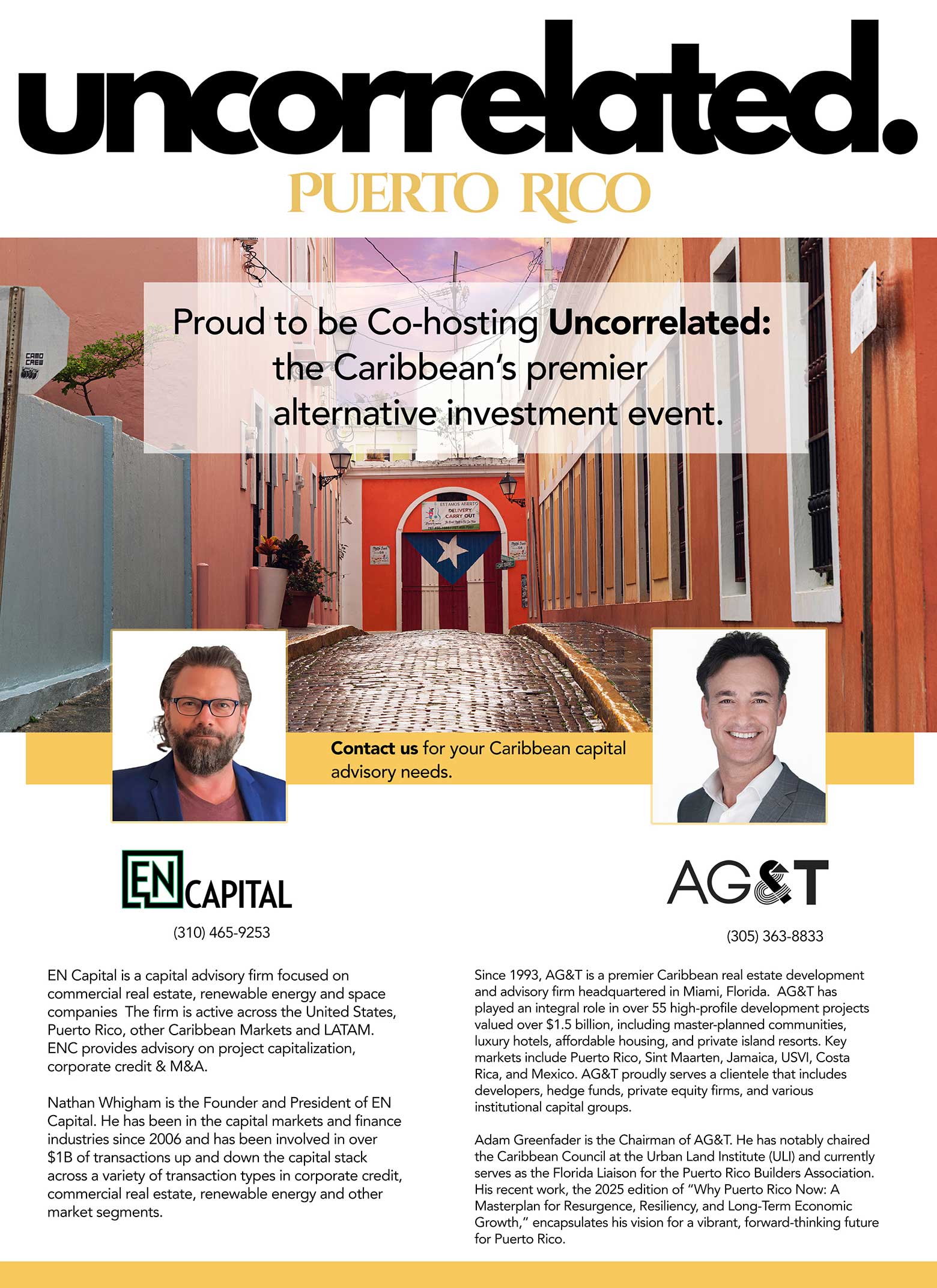
Over the past several years, AG&T has worked closely with Uncorrelated to expand the conversation around alternative investment and real estate finance in the region. As Co-Host of the Uncorrelated Puerto Rico conferences in both 2025 and 2026, AG&T has helped bring together leading allocators, family offices, investment managers, banks, developers, and government leaders to identify new sources of capital and foster strategic partnerships for Caribbean projects.

In this article, Adam Greenfader examines the structural changes affecting Caribbean capital markets—from Basel III regulations and the tightening of commercial lending to the growing role of private credit, family offices, syndicated financing, and mission-driven investment. The article also highlights practical strategies that developers can employ to improve bankability, strengthen capital structures, and position projects for success in today’s increasingly selective financing environment.

As the Caribbean continues to attract global investors seeking diversification and long-term growth, AG&T remains committed to helping clients navigate complex capital markets while building relationships that connect innovative projects with the right sources of equity and debt financing.


(Continue with the original published article.)

By Adam Greenfader, Chair of AG&T,  In collaboration with Nate Whigham, EN Capital


Background

Unlocking Caribbean Capital – What’s the lock.

During normal times, the Caribbean region is generally a challenge. The region is highly regulated and has a low risk tolerance from traditional lending. Scale and the vast diversity of the region is always an issue for the larger lenders that want to play in the space.

Bank Failures

In 2023 bank failures and new capital regulations under the Basel III agreements, which we were expecting to force traditional banks to hold more cash reserves.  There is approximately 1 trillion dollars of U.S. commercial paper that will be coming due in the next 12 months.

Historic Money Tightening

While inflation showed signs of easing, the impact of U.S. monetary policy on the Caribbean in 2024 and beyond remained a topic of debate among economists, with some predicting minimal disruption, while others expressed concerns about its potential to affect trade and investment flows in the region.

Last year the U.S. Federal Reserve continued implementing aggressive monetary tightening. This policy aimed to reduce aggregate demand (GDP Growth), leading to a notable slowdown in U.S. economic growth—from 4.9% in Q3 2023 to 1.7% at the end of 2024,

The Cost of Capital

Interest rates (as well as the cost of materials went up) in 2024 started to come down but still high – making it harder for many projects to make their development proformas. A typical hotel construction loan in 2024 might have an 11.5% interest rate with a 55% loan to cost from a traditional construction lender and several points higher from private equity and alternative capital groups like family offices.

Lastly, but certainly not the least of the concerns, insurance costs continue to go up with many lenders seeking ways to mitigate climate risk.

So, while many financial institutions have put their pencils down, other groups are proceeding cautiously today in the Caribbean.

Keys To Capital 2024

There is a consensus that there will be new opportunities in the future for private capital, family offices, private debt funds, and fintech to fill the 2024 Caribbean capital stack.

Stronger Sponsors and Guarantees

As rates are going up, Caribbean financial institutions also seem to be seeking stronger sponsors and guarantees. The group felt that working with known sponsors was a top priority. In other words, developers that have experience in the Caribbean region with the specific product type. More importantly, there was ample talk about creating multiple layers of capital protection. This includes full recourse loans (i.e., personal guarantees) as well robust completion guarantees and bonds. One participant was quoted as saying,

“we are looking for every single type of guarantee possible today.”

Land Lift is Dead

Lenders seem to only want to underwrite the original cash basis of the land today and not give the sponsor any credit for the increased value.

Condo-hotel Presales

On the hospitality side, one participant mentioned that they like to see condo-hotel projects because pre-sales can mitigate risk. In addition to demonstrating market acceptance, condo-hotel presales reduce the overall total capital requirements. The discussed presale requirements varied from 35%-65% of the total project.

Syndication of Loans and Risk Bifurcation

As lenders seek to mitigate risk, Caribbean capital sources are taking smaller bites of the proverbial capital stack. On the debt side, hotel deals are getting done by bifurcating or dividing the loan into parts. It is common in today’s market for banks to be syndicating their loans or splitting them up with other financial institutions. One of the participants mentioned that they recently closed a 200-million dollar hospitality construction loan by dividing the loan into two parts: capital for the hotel and a separate debt instrument for the condo-hotel uses.


Mission Driven Projects

While there is a general slowdown of construction lending in general, mission driven developments still are attractive. Mission driven developments can be defined as projects or locations that have unique stories to tell. Below are the four of the top mission driven locations:

About AG&T

AG&T is a real estate development and consulting company based in Miami, Florida with a track record that spans over 52 real estate projects in Puerto Rico, the Caribbean, Central America, and the United States. Core services include Hospitality Development, Investment Sales, Strategic Planning, and Capital Advisory (Equity | Debt). www.agandt.com


Bridging Global Capital with Regional Opportunity

Bridging Global Capital with Regional Opportunity


As hospitality investment continues to accelerate across the Caribbean and Latin America, access to capital has become one of the defining factors separating projects that move forward from those that remain on the drawing board.

To better understand the evolving financing landscape, Tim Gifford, Managing Director, Capital Advisors – Latin America for CBRE Investment Banking, joined Adam Greenfader, Chairman of AG&T, for a discussion on the state of Caribbean and Latin American capital markets in 2024.

The conversation explored how lenders and institutional investors are evaluating opportunities across the region, the impact of higher interest rates on financing structures, changing debt spreads, underwriting standards, and the outlook for hospitality and mixed-use development.

Capital Markets Are Opening Again

Following several years of rising interest rates and increased market uncertainty, capital markets are gradually becoming more active.

According to Tim Gifford, lenders have become increasingly selective, placing greater emphasis on sponsor experience, project quality, market fundamentals, and conservative underwriting. While financing remains available for well-conceived developments, both pricing and loan structures have evolved significantly compared to the low-interest-rate environment that characterized the previous decade.

Debt spreads, leverage ratios, and loan terms now reflect a greater focus on risk management and long-term project performance.

For experienced developers with strong projects, however, capital continues to be available.

A Flight to Quality

One of the most important themes discussed was the continued strength of institutional interest in high-quality hospitality assets.

Luxury resorts, branded residences, mixed-use communities, and destination developments throughout the Caribbean continue to attract attention from lenders and investors seeking long-term opportunities supported by strong tourism fundamentals.

The Caribbean’s limited supply of premium beachfront sites, growing international tourism, expanding airlift, and increasing demand for experiential travel continue to support long-term investor confidence.

Institutional capital remains highly interested in projects that combine exceptional locations with experienced development teams and realistic business plans.

Bridging Institutional Capital with Regional Developers


While global firms such as CBRE Investment Banking advise many of the world’s largest transactions, the Caribbean market is also characterized by entrepreneurial developers undertaking projects that may be too small to attract the attention of major international investment banks. This is where AG&T has developed a unique role.

For more than three decades, AG&T has worked alongside regional developers, family-owned businesses, landowners, and hospitality entrepreneurs throughout Puerto Rico, Sint Maarten, Costa Rica, Panama, the Dominican Republic, and other Caribbean markets.

Many of these projects fall below the transaction size typically served by the largest global advisory firms, yet they remain critically important to the economic development of the region.

AG&T helps bridge this gap by assisting clients with project positioning, feasibility analysis, capital structuring, strategic partnerships, market intelligence, and introductions to lenders, equity investors, hospitality brands, and institutional capital sources.

Our objective is to help promising projects become investment-ready and position them to access increasingly sophisticated sources of financing.

New Development Continues

Despite higher financing costs, development activity throughout the Caribbean remains remarkably resilient.

Luxury hospitality, branded residences, resort communities, marina developments, mixed-use projects, and infrastructure investments continue to move forward across many island markets.

Developers are responding to evolving consumer preferences by emphasizing wellness, sustainability, resilient design, experiential travel, and integrated lifestyle communities.

Institutional investors continue to recognize the Caribbean’s long-term strengths:

  • Limited luxury inventory.

  • Exceptional natural assets.

  • Strong tourism demand.

  • Expanding international connectivity.

  • Increasing interest in branded residential products.

  • Growing demand for resilient, sustainable development.

These fundamentals continue to support investment even as financing markets become more disciplined.

Looking Ahead

The discussion concluded with a cautiously optimistic outlook.

While capital is no longer as inexpensive or abundant as it was several years ago, the market has become healthier and more disciplined. Projects supported by experienced sponsors, realistic financial assumptions, and strong market fundamentals continue to attract both debt and equity capital.

For Caribbean developers, success increasingly depends on thoughtful planning, disciplined execution, and assembling the right team of advisors, lenders, operators, and investors.

At AG&T, we believe our role extends beyond traditional consulting. We help connect local opportunity with global capital.

By working closely with regional developers while maintaining relationships with leading international firms such as CBRE and many of the world’s largest hospitality brands, lenders, and institutional investors, AG&T serves as a bridge between entrepreneurial vision and sophisticated capital markets.

As Caribbean hospitality enters its next phase of growth, those connections will become more valuable than ever.

Caribbean Capital in 2024

Unlocking Caribbean Capital

ByAdam Greenfader, Chair of AG&T andAmanda Staerker, Luxury Development Specialist. Saint Barths Mansions. Photo Credit: Lovephotolove AG&Trecently brought together a group of leading capital experts to discuss the Caribbean capital markets outlook for 2024.

Continue reading

Caribbean Capital Markets Outlook 2024

Caribbean Capital

Caribbean Capital Markets 2024 

By Adam Greenfader, Chair of AG&T and Amanda Staerker, Luxury Development Specialist. 

AG&T recently brought together a group of leading capital experts to discuss the Caribbean capital markets outlook for 2024. The conversation was a closed door session with the names of the participants withheld in order to insure confidentiality. Some of the companies in attendance include CBRE Capital Markets Group, Sion Capital, Greystone, Glide Capital, Regions Bank , Crowdstreet, Citigroup, Ocean Bank, GG Capital Group, Driftwood Capital, Harbour Capital Partners, EnCapital, Ranger Alternative Management, Optimum Bank, and Mullen Capital. 

The U.S. Federal Reserve in 2023 embarked on one of the most aggressive tightening of monetary policies in recent history. The goal was to curtail aggregate demand. The policy was highly successful as growth slowed more than half from 4.9% in Q3 to 2.1% in Q4. While this deceleration in growth should dampen inflation, the consensus about the effects of the tight U.S. monetary policy on the Caribbean in 2024 was mixed.

The good news is that new construction deals are still getting done in the Caribbean. The bad news, is that the cost of capital is going-up. During the conversation, several recent term sheets were discussed, with the group agreeing that a typical hotel construction loan in 2024 might have an 11.5% interest rate with a 55% loan to cost. 

As rates are going up, Caribbean financial institutions also seem to be seeking stronger sponsors and guarantees. The group felt that working with known sponsors was a top priority. In other words, developers that have experience in the Caribbean region with the specific product type. More importantly, there was ample talk about creating multiple layers of capital protection. This includes full recourse loans (i.e., personal guarantees) as well robust completion guarantees and bonds. One participant was quoted as saying, “we are looking for every single type of guarantee possible today.”

Lenders seem to only want to underwrite the original cash basis of the land today and not give the sponsor any credit for the increased value.

On the hospitality side, one participant mentioned that they like to see condo-hotel projects because pre-sales can mitigate risk. In addition to demonstrating market acceptance, condo-hotel presales reduce the overall total capital requirements. The discussed presale requirements varied from 35%-65% of the total project.

As lenders seek to mitigate risk, Caribbean capital sources are taking smaller bites of the proverbial capital stack. On the debt side, hotel deals are getting done by bifurcating or dividing the loan into parts. It is common in today’s market for banks to be syndicating their loans or splitting them up with other financial institutions. One of the participants mentioned that they recently closed a 200-million dollar hospitality construction loan by dividing the loan into two parts: capital for the hotel and a separate debt instrument for the condo-hotel uses.

While there is a general slowdown of construction lending in general, mission driven developments still are attractive. Mission driven developments can be defined as projects or locations that have unique stories to tell. Below are the four of the top mission driven locations: 

1. Mexico, the group discussed how “Near-Shoring” is driving massive investment in industrial facilities from international companies such as Tesla that want to be closer to the U.S. This includes significant involvement from the Chinese. One of the participants stated, “there is 10x the amount of capital for every opportunity in Northern Mexico today”.

2. Guayana, mentioned as “the fastest growing economy in whole word”, the rush to build hospitality is palpable. Lack of supply is so limited in the capital of Georgetown for example, that older assets like the Marriott is getting ADRs upwards of $450 per night. There was caution, however, if with new supply that rates would hold into the future.

3. Costa Rica continues to provide amazing lifestyle offerings with its “blue economy” however while there is much interest to finance projects in this location, identifying truly “shovel ready projects” seemed to be a top of mind concern for some of the participants.

4. Puerto Rico was highlighted by many as being the “safest and most lucrative hospitality market in the Caribbean today.” There was a general agreement that the U.S. island of Puerto Rico currently has very low supply of inventory (tourism GDP is at 6.75%) as well some very lucrative tax incentives under act 74. “In Puerto Rico, you get a 40% tax credit that you can sell, there is no other place in the Caribbean that gives you that kind of IRR boost”, quoted a major hotel investor.

During normal times, the Caribbean region is generally a challenge. The region is highly regulated and has a low risk tolerance from traditional lending. Today, the fear caused by the 2023 bank failures and new capital regulations under the Basel III agreements, should force traditional banks to hold more cash reserves. It was suggested that there is approximately 1 trillion dollars of U.S. commercial paper that will be coming due in the next 12-24 months. There was concern from the group that if interest rates remain at current levels, many borrowers will have to make-up their interest reserves with new equity. One banker in the group, who recently underwrote their entire portfolio stated, “I am not sure how many projects will be able to come to the table with more money.” There is hope, however, for the Fed’s recent announcement of three rates cuts in 2024. 

So, while many financial institutions have put their pencils down, other groups are proceeding cautiously today in the Caribbean. There is a consensus that there will be new opportunities in the future for private capital, family offices, private debt funds, and fintech to fill the 2024 Caribbean capital stack.

AG&T is a real estate development and consulting company based in Miami, Florida with a track record that spans over 52 real estate projects in Puerto Rico, the Caribbean, Central America, and the United States. Core services include Hospitality Development, Investment Sales, Strategic Planning, and Capital Advisory (Equity | Debt). www.agandt.com

Pitching Caribbean Capital: Creating a Marketplace for Caribbean Investment

Pitching Caribbean Capital: Creating a Marketplace for Caribbean Investment

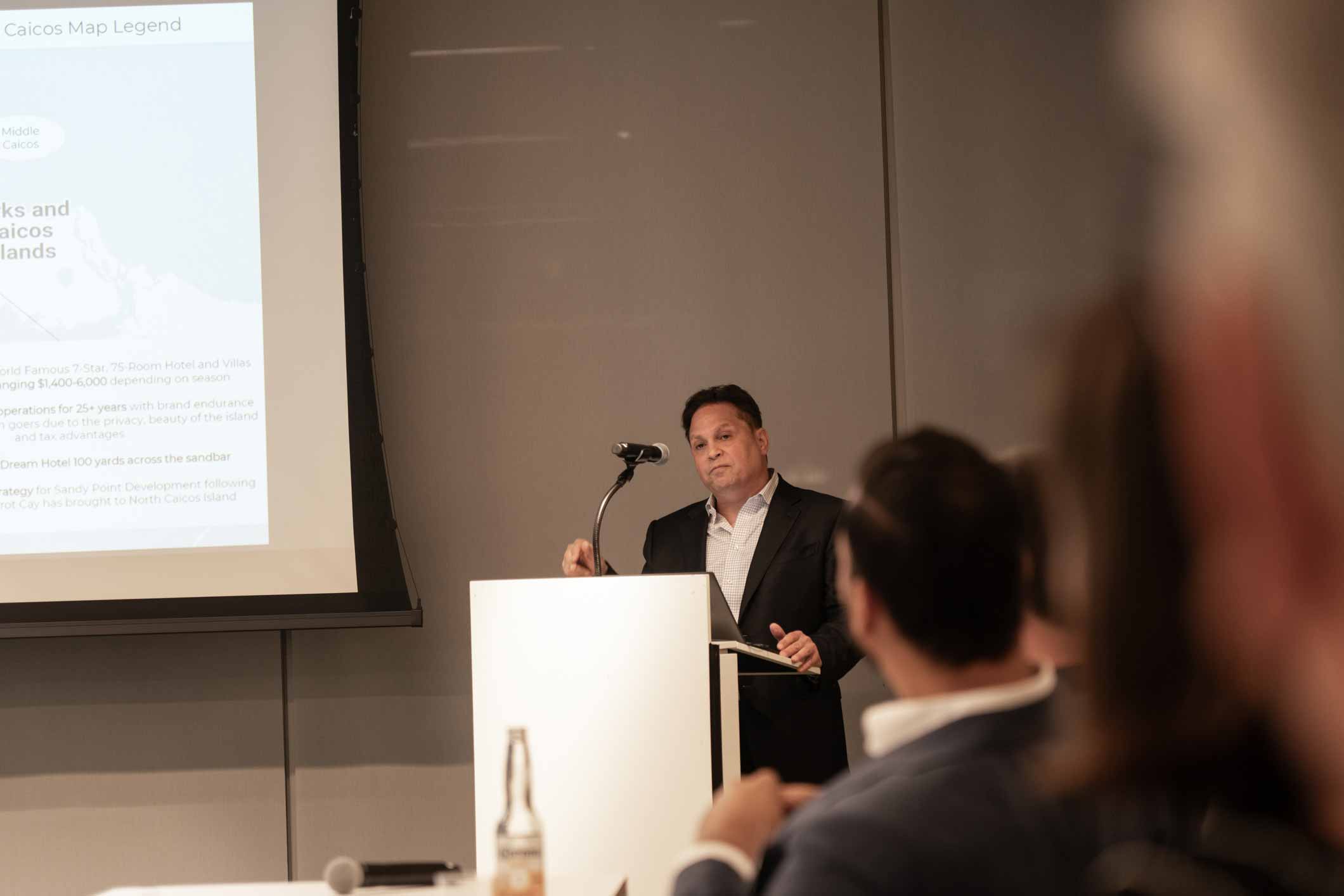
Bringing together developers and capital has always been central to AG&T’s mission. Through ULI Southeast Florida/Caribbean, Pitching Caribbean Capital was created as a Shark Tank-style forum where promising Caribbean developments are presented before experienced investors, lenders, and industry experts, fostering collaboration, constructive feedback, and new investment opportunities across the region.

More than a competition, the program was created to foster meaningful dialogue between developers and the capital markets. Participants received valuable feedback from experienced professionals in finance, development, construction, sustainability, and investment, helping refine both their projects and their investment strategies.


The Caribbean is home to extraordinary development opportunities, yet one of the region’s greatest challenges remains connecting visionary projects with experienced investors, lenders, and strategic partners.

The 2023 forum featured two outstanding development opportunities:

  • Sandy Point, Turks & Caicos, presented by Brad Lamensdorf, highlighting the continued strength of luxury resort and residential investment in one of the Caribbean’s premier destinations.

  • Town Center at Palmas del Mar, Puerto Rico, presented by Andrew Carlson and Nathan Whigham, illustrating the evolution of one of Puerto Rico’s most successful master-planned communities.

An accomplished panel of industry experts evaluated each presentation, offering thoughtful perspectives on market positioning, project feasibility, capital structure, sustainability, and long-term execution. The discussions demonstrated the value of bringing together professionals with diverse backgrounds and decades of real estate experience.

The success of the event reflected something even more important than the projects themselves: the growing collaboration taking place across the Caribbean real estate community. Developers, investors, consultants, attorneys, engineers, and public-sector leaders are increasingly working together to share knowledge, strengthen relationships, and expand access to capital throughout the region.

AG&T is proud to have helped establish a platform that encourages these conversations. Throughout our more than 35 years advising clients across the Caribbean, we have found that successful projects are built not only on strong fundamentals, but also on trusted relationships and informed collaboration.

We extend our sincere appreciation to Akerman LLP for hosting the event, our distinguished panelists for sharing their expertise, and the many volunteers and ULI leaders whose dedication made the program possible.

As a longtime leader within the Urban Land Institute, AG&T remains committed to advancing responsible development, promoting regional collaboration, and helping connect exceptional Caribbean projects with the people and capital needed to bring them to life.

Why Puerto Rico? Understanding the Island’s Unique Investment Advantage

Adam Greenfader Investing Mastermind

Why Puerto Rico? Understanding the Island's Unique Investment Advantage

The Puerto Rico Investing Mastermind brought together investors, entrepreneurs, developers, attorneys, tax professionals, and economic development leaders to explore the opportunities reshaping Puerto Rico’s economy. Hosted in Condado, San Juan, the program focused on the island’s unique investment advantages, including its strategic relationship with the United States, Act 60 tax incentives, Qualified Opportunity Zones, real estate development, and emerging business sectors.

The program featured presentations and discussions led by Adam Greenfader, Chairman of AG&T; Ashley Tison, Opportunity Zone attorney and national expert; Brett Siglin, real estate investor and educator; Brian Bourgerie, entrepreneur and investor; Kathryn Morea, Puerto Rico business strategist; Joel Berrocal, economic development professional; Michael Gay, CEcD, economic development executive; Samira Yassin, CPA, Esq., tax and legal advisor; and Veronica Montalvo, business and investment advisor. Together, the speakers provided a multidisciplinary perspective on why Puerto Rico has become one of the most compelling investment destinations under the U.S. flag and how public policy, private investment, and entrepreneurship are helping shape the island’s next chapter of economic growth.


Puerto Rico occupies a unique position unlike anywhere else in the Caribbean.

As a U.S. territory, the island combines the legal certainty, financial framework, and market access of the United States with the strategic location, climate, and lifestyle of the Caribbean. This distinctive combination has made Puerto Rico one of the region’s most compelling destinations for business expansion, hospitality development, manufacturing, technology, and real estate investment.

These themes formed the basis of a recent Puerto Rico Investing Mastermind, where investors, entrepreneurs, developers, and business leaders came together to explore the opportunities shaping the island’s next chapter of economic growth.

Rather than focusing solely on individual investment opportunities, the discussion centered on a broader question:

Why is Puerto Rico attracting increasing attention from investors across the United States and around the world?

A Strategic Bridge Between the U.S. and the Caribbean

Puerto Rico offers advantages that extend far beyond its tropical setting.

Operating under the U.S. Constitution, federal banking regulations, intellectual property protections, and established legal framework, the island provides investors with a level of certainty that is difficult to replicate elsewhere in the region.

English and Spanish are widely spoken, the workforce is highly educated, and businesses benefit from direct access to the U.S. financial system while operating in one of the most strategically located jurisdictions in the Caribbean.

For companies serving both North American and Latin American markets, Puerto Rico functions as a natural gateway between the two.

A Competitive Tax Environment

Puerto Rico has also developed one of the most comprehensive economic development strategies in the United States.

Through Act 60, the island offers targeted incentives designed to encourage export services, advanced manufacturing, technology, research and development, hospitality investment, and new business formation. These incentives have helped attract entrepreneurs, investment managers, family offices, technology companies, and professional service firms seeking to establish long-term operations on the island.

The objective has never been simply to reduce taxes.

It has been to create jobs, diversify the economy, stimulate private investment, and encourage innovation across multiple industries.

As Puerto Rico continues to evolve, these incentives remain an important component of a broader economic development strategy focused on long-term competitiveness.

One of America’s Largest Opportunity Zone Markets

Another distinctive advantage is Puerto Rico’s extensive network of Opportunity Zones.

Approximately 98% of the island has been designated as Qualified Opportunity Zones, creating one of the largest concentrations of Opportunity Zone investment opportunities anywhere under U.S. jurisdiction.

These areas encompass urban redevelopment districts, waterfront communities, hospitality destinations, mixed-use projects, industrial properties, and significant portions of the island’s residential and commercial real estate market.

For developers and long-term investors, the Opportunity Zone program has provided an additional incentive to deploy capital into projects that contribute to economic revitalization while benefiting from favorable federal tax treatment.

Combined with local incentives, this creates a uniquely attractive investment environment.

More Than Tax Advantages

While incentives often attract initial attention, they are rarely the sole reason investors choose Puerto Rico.

The island offers a combination of characteristics that continue to drive long-term investment:

  • A highly educated bilingual workforce.

  • Strong manufacturing and life sciences sectors.

  • Expanding technology and innovation ecosystems.

  • Modern airports, ports, and telecommunications infrastructure.

  • World-class hospitality and tourism.

  • Access to U.S. capital markets.

  • A growing entrepreneurial community.

  • An exceptional quality of life.

Increasingly, investors are choosing Puerto Rico not simply because of tax policy, but because they recognize the island’s long-term economic potential.

A New Generation of Investment

Over the past decade, Puerto Rico has experienced the emergence of a new generation of entrepreneurs, investors, and business leaders.

Technology companies, digital asset firms, investment managers, manufacturers, hospitality operators, healthcare providers, and family offices have joined long-established local businesses in helping diversify the island’s economy.

At the same time, significant federal infrastructure investment has accelerated modernization efforts across transportation, energy, water systems, housing, and public facilities.

Together, these trends are creating one of the most dynamic investment environments in the Caribbean.

AG&T’s Perspective

Having worked in Puerto Rico for more than three decades, AG&T has witnessed the island’s remarkable evolution firsthand.

Our experience spans residential communities, hospitality developments, mixed-use projects, institutional advisory assignments, and strategic planning initiatives across the island.

Throughout that time, one lesson has remained constant.

Puerto Rico’s greatest strength is not any single incentive program. It is the combination of its people, its strategic location, its legal and financial framework, its entrepreneurial culture, and its unique relationship with the United States.

Those advantages cannot be replicated elsewhere in the Caribbean.

As Puerto Rico continues to strengthen its economy and expand its global connections, we believe the island is well positioned to become one of the leading destinations for investment, innovation, and sustainable development throughout the Americas.

The opportunity extends far beyond tax incentives.

It is about participating in the long-term transformation of one of the Caribbean’s most resilient and promising economies.