
ga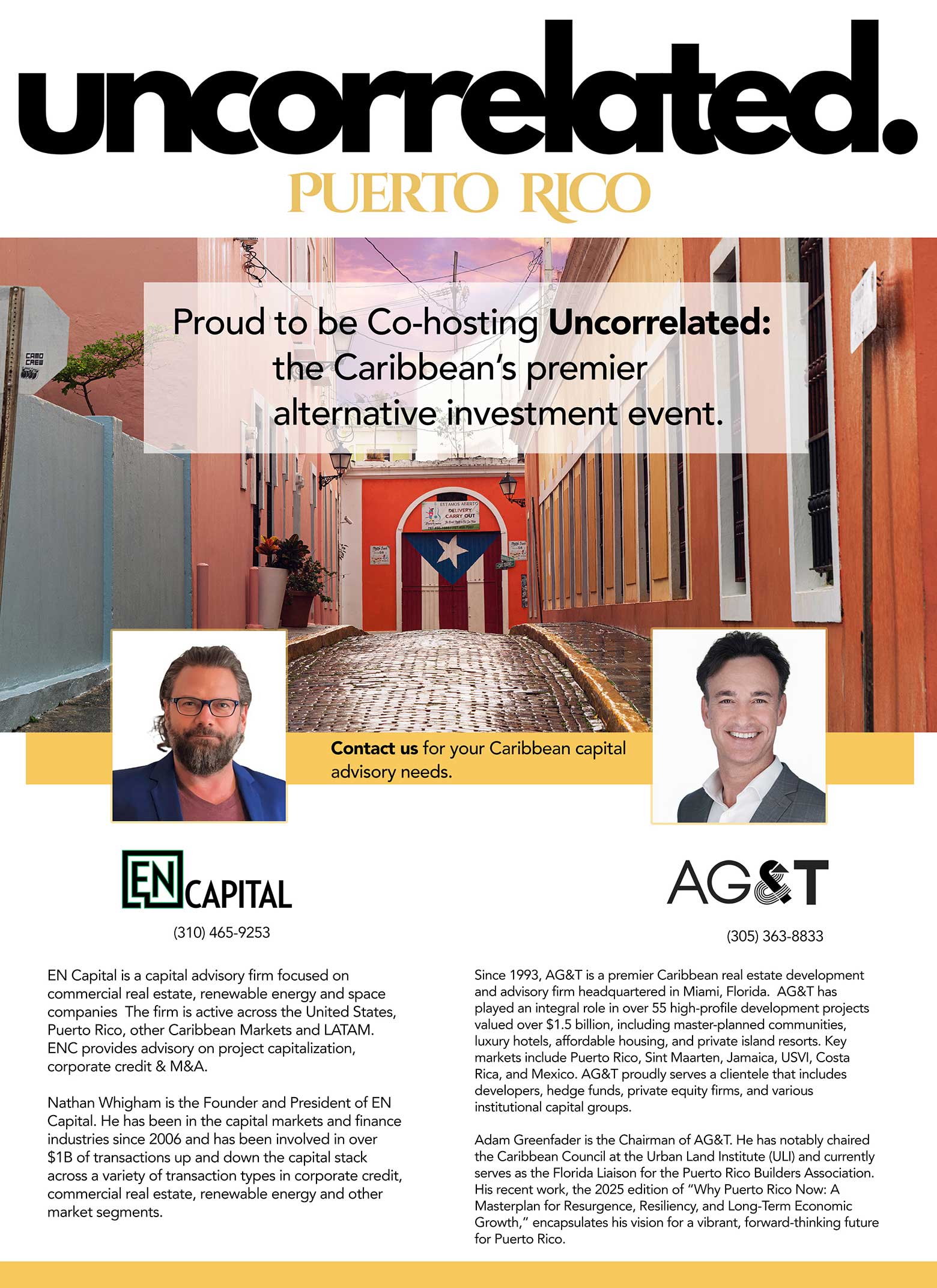 zine
zine
Access to capital has always been one of the defining challenges—and greatest opportunities—for real estate development in the Caribbean. As global financial markets evolve, developers and investors must navigate a rapidly changing capital environment shaped by higher interest rates, tighter lending standards, climate risk, and the emergence of alternative financing sources.
This article was originally published in Uncorrelated Magazine as part of AG&T’s ongoing collaboration with Uncorrelated and EN Capital to explore innovative approaches to financing Caribbean real estate. It reflects AG&T’s commitment to connecting developers, investors, family offices, private credit providers, and institutional capital with opportunities throughout Puerto Rico and the broader Caribbean.
Over the past several years, AG&T has worked closely with Uncorrelated to expand the conversation around alternative investment and real estate finance in the region. As Co-Host of the Uncorrelated Puerto Rico conferences in both 2025 and 2026, AG&T has helped bring together leading allocators, family offices, investment managers, banks, developers, and government leaders to identify new sources of capital and foster strategic partnerships for Caribbean projects.
In this article, Adam Greenfader examines the structural changes affecting Caribbean capital markets—from Basel III regulations and the tightening of commercial lending to the growing role of private credit, family offices, syndicated financing, and mission-driven investment. The article also highlights practical strategies that developers can employ to improve bankability, strengthen capital structures, and position projects for success in today’s increasingly selective financing environment.
As the Caribbean continues to attract global investors seeking diversification and long-term growth, AG&T remains committed to helping clients navigate complex capital markets while building relationships that connect innovative projects with the right sources of equity and debt financing.
(Continue with the original published article.)
By Adam Greenfader, Chair of AG&T, In collaboration with Nate Whigham, EN Capital
Background
Unlocking Caribbean Capital – What’s the lock.
During normal times, the Caribbean region is generally a challenge. The region is highly regulated and has a low risk tolerance from traditional lending. Scale and the vast diversity of the region is always an issue for the larger lenders that want to play in the space.
Bank Failures
In 2023 bank failures and new capital regulations under the Basel III agreements, which we were expecting to force traditional banks to hold more cash reserves. There is approximately 1 trillion dollars of U.S. commercial paper that will be coming due in the next 12 months.
Historic Money Tightening
While inflation showed signs of easing, the impact of U.S. monetary policy on the Caribbean in 2024 and beyond remained a topic of debate among economists, with some predicting minimal disruption, while others expressed concerns about its potential to affect trade and investment flows in the region.
Last year the U.S. Federal Reserve continued implementing aggressive monetary tightening. This policy aimed to reduce aggregate demand (GDP Growth), leading to a notable slowdown in U.S. economic growth—from 4.9% in Q3 2023 to 1.7% at the end of 2024,
The Cost of Capital
Interest rates (as well as the cost of materials went up) in 2024 started to come down but still high – making it harder for many projects to make their development proformas. A typical hotel construction loan in 2024 might have an 11.5% interest rate with a 55% loan to cost from a traditional construction lender and several points higher from private equity and alternative capital groups like family offices.
Lastly, but certainly not the least of the concerns, insurance costs continue to go up with many lenders seeking ways to mitigate climate risk.
So, while many financial institutions have put their pencils down, other groups are proceeding cautiously today in the Caribbean.
Keys To Capital 2024
There is a consensus that there will be new opportunities in the future for private capital, family offices, private debt funds, and fintech to fill the 2024 Caribbean capital stack.
Stronger Sponsors and Guarantees
As rates are going up, Caribbean financial institutions also seem to be seeking stronger sponsors and guarantees. The group felt that working with known sponsors was a top priority. In other words, developers that have experience in the Caribbean region with the specific product type. More importantly, there was ample talk about creating multiple layers of capital protection. This includes full recourse loans (i.e., personal guarantees) as well robust completion guarantees and bonds. One participant was quoted as saying,
“we are looking for every single type of guarantee possible today.”
Land Lift is Dead
Lenders seem to only want to underwrite the original cash basis of the land today and not give the sponsor any credit for the increased value.
Condo-hotel Presales
On the hospitality side, one participant mentioned that they like to see condo-hotel projects because pre-sales can mitigate risk. In addition to demonstrating market acceptance, condo-hotel presales reduce the overall total capital requirements. The discussed presale requirements varied from 35%-65% of the total project.
Syndication of Loans and Risk Bifurcation
As lenders seek to mitigate risk, Caribbean capital sources are taking smaller bites of the proverbial capital stack. On the debt side, hotel deals are getting done by bifurcating or dividing the loan into parts. It is common in today’s market for banks to be syndicating their loans or splitting them up with other financial institutions. One of the participants mentioned that they recently closed a 200-million dollar hospitality construction loan by dividing the loan into two parts: capital for the hotel and a separate debt instrument for the condo-hotel uses.
Mission Driven Projects
While there is a general slowdown of construction lending in general, mission driven developments still are attractive. Mission driven developments can be defined as projects or locations that have unique stories to tell. Below are the four of the top mission driven locations:
About AG&T
AG&T is a real estate development and consulting company based in Miami, Florida with a track record that spans over 52 real estate projects in Puerto Rico, the Caribbean, Central America, and the United States. Core services include Hospitality Development, Investment Sales, Strategic Planning, and Capital Advisory (Equity | Debt). www.agandt.com