
Puerto Rico: What a difference three years can make.
When I released the first edition of Why Puerto Rico Now three years ago, the island was just beginning to emerge from one of the most challenging chapters in its modern history. Since then, Puerto Rico has undergone a remarkable transformation—economically, demographically, and institutionally.
This month, I’m releasing Version 2.0 of my book Why Puerto Rico Now to reflect the significant progress, new data, and structural shifts that have taken place. The goal remains the same: to offer investors, financial leaders, and policymakers a clear-eyed view of Puerto Rico’s trajectory and its growing relevance in the global economic landscape.
In the article below, I’ve summarized the ten most impactful changes that have taken place since the original publication—ranging from GDP growth and post-bankruptcy recovery to the boom in real estate, tourism, and fintech. These developments not only mark a turning point for Puerto Rico but also offer new opportunities for those focused on long-term, sustainable investment strategies. What Has Changed in the Last Three Years?
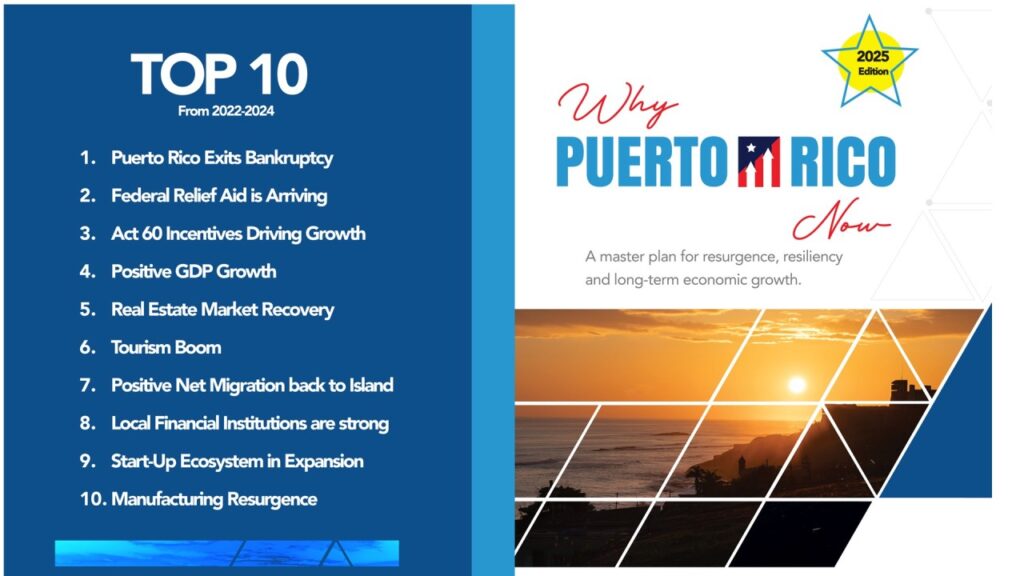
1. Puerto Rico Exits Bankruptcy
On March 15, 2022, Puerto Rico officially emerged from the largest municipal bankruptcy in U.S. history. Public debt was reduced from $70 billion to $34 billion. The restructuring restored access to capital markets, allowing the island to refinance debt and invest in growth.
2. Federal Relief Is Flowing In—Slowly But Surely
While federal disaster aid has been slow to reach the ground, the totals are unprecedented:
$91.3 billion allocated between 2021–2025. $84.4 billion obligated and $38.7 billion disbursed. Programs like CDBG-DR are critical for infrastructure and housing resilience.
3. Act 60 Incentives Accelerate Growth
The Act 60 program has been a magnet for capital and human talent: 12% year-over-year increase in new applications (2023 vs. 2022). 40,000+ jobs created in finance, tech, and real estate. By 2029, projections show: $7.4 billion in real estate purchases,$450 million in rental income, $1 billion in direct spending from new residents and investors
4. A Return to Positive GDP Growth
After over a decade of contraction, Puerto Rico’s economy is rebounding: 2018: GDP declined -4.36% following Hurricane Maria. 2021–2022: Recovery with 0.39% and 3.57% growth, respectively. Outlook: 1.5% to 3.5% annual GDP growth through the next decade.
5. Real Estate Markets Recover and Expand
Puerto Rico’s property markets have shifted dramatically since 2021: Luxury home values have doubled in many areas. Investment is moving beyond coastal resorts into suburban and urban zones. The real estate sector is expected to remain a key engine for growth.
6. Tourism Industry Sets New Records
Public-private partnerships, particularly the Discover Puerto Rico DMO, have fueled record-breaking performance: $8.9 billion in tourism revenue (2022) — up 39% from 2019. Visitors grew from 2.75 million (2021) to 6.1 million (2024). 2025 projections estimate an additional 1–5% growth.
7. Net Migration Turns Positive
After years of population decline: In 2023, net migration became positive for the first time in 15 years. 22,200 new residents arrived (6.938 per 1,000 residents). With continued growth, the island is reversing its “brain drain” narrative.
8. Stronger Local Financial Institutions
Puerto Rico’s financial system is stabilizing: Banks like Banco Popular, FirstBank, and Oriental improved Tier 1 Capital ratios. Growth of the alternative finance sector: 6 commercial banks with $75 billion in assets. 27 International Banking Entities (IBEs) managing $59.3 billion.
9. Start-Up Ecosystem on the Rise
A new tech and finance ecosystem is emerging: 1,247 private companies operate across sectors. 96 fintech start-ups include Zenus Bank, EVERTEC, FV Bank, Ready Player DAO, and Olé Life. The island is positioning itself as a Caribbean innovation hub.
10. Manufacturing and Pharma Re-Shoring
The U.S. is bringing supply chains closer to home—and Puerto Rico is benefitting: 80+ pharmaceutical plants produce 16 of the 20 top-selling U.S. drugs. Puerto Rico ranks #2 in pharmaceutical exports, accounting for 17.6% of total U.S. output.
Conclusion: A Blueprint for Financial, Climate, and Industrial Resilience
Puerto Rico is not just recovering—it is transforming.With stronger financial institutions, historic levels of federal funding, robust tax incentives, and a revitalized private sector, the island is laying the foundation for sustainable economic independence and long-term growth.
But transformation alone is not enough. In the face of accelerating climate change, the island must also become a model for resilience—through clean energy adoption, adaptive infrastructure, and inclusive development strategies. Puerto Rico’s unique geography and regulatory advantages make it an ideal testing ground for climate-smart investment and innovation.
Adding to the momentum is the new U.S. administration’s renewed commitment to the “America First” agenda, which emphasizes reshoring critical manufacturing, especially in the pharmaceutical, biotech, and industrial sectors. Puerto Rico, already home to over 80 pharmaceutical plants and a skilled bilingual workforce, is positioned to reclaim its role as a vital hub for U.S. strategic supply chains.
For institutional investors, family offices, financial institutions, and policymakers, the message is clear and urgent:
Rebuild stronger, smarter, and more sustainably.
Invest in climate-adaptive infrastructure and industry.
Capitalize on U.S. reshoring and nearshoring strategies.
Partner with a region that is redefining economic development in real time.
Puerto Rico represents a rare convergence of opportunity, resilience, and policy alignment. Now is the time to reassess Puerto Rico’s value proposition—not only as a growth market, but as a future-proof investment platform in an increasingly uncertain world.
About Adam Greenfader
About The Author

Adam Greenfaderis a real estate developer, advisor, and author with over 30 years of experience building resilient communities throughout the Caribbean, Latin America, and the United States. AsChairman of AG&T, a Miami-based advisory and development firm, Adam has worked on more than55 projects valued at over $1.5 billion, specializing in coastal, hospitality, and mixed-use developments.
Adam moved to Puerto Rico in 1993 and spent 25 years on the island, where he and his wife raised their two children. During this time, he became a recognized leader in sustainable development, climate adaptation, and post-disaster recovery. He is a long-time member of thePuerto Rico Builders Association, theCaribbean Green Building Council, and theUrban Land Institute’s Southeast Florida/Caribbean Committee.
Originally published on LinkedIn on March 27, 2025.
Adam Greenfader is Chairman of AG&T, a Caribbean real estate capital advisory firm with more than three decades of experience structuring and executing real estate development projects across the Caribbean and Latin America, with over two billion USD in aggregate value.